Iowa Quality Career & Technical Education
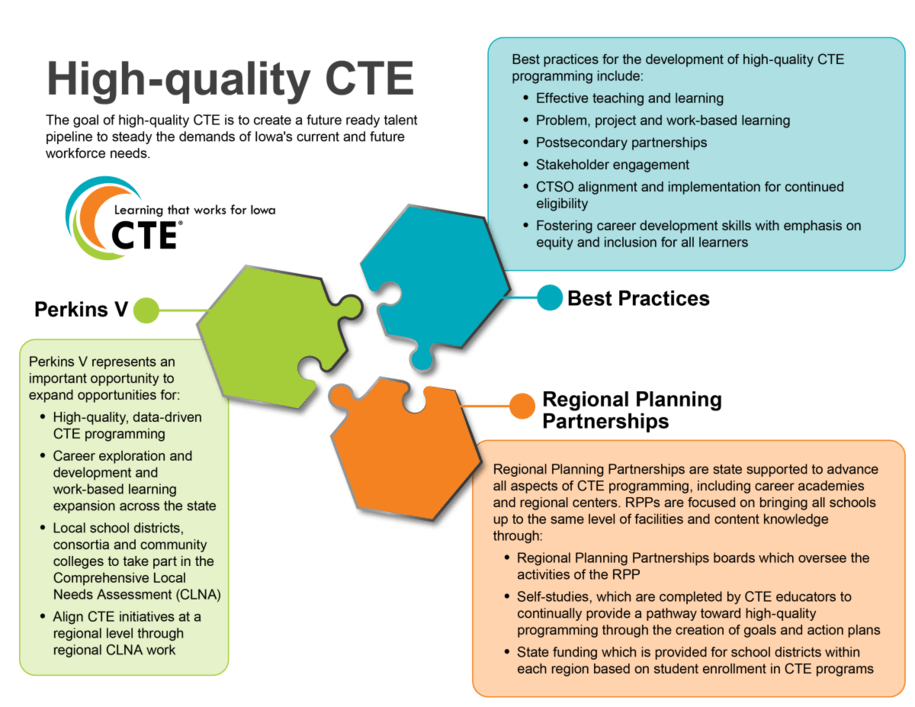
Iowa’s Career & Technical Education (CTE) programs build Iowa’s talent pipeline and support the Future Ready Iowa goal that 70 percent of Iowans in the workforce have education and training beyond high school by 2025. Bringing together Regional Planning Partnerships, the Perkins V State plan, and best practices in career and technical education complete Iowa’s framework for high-quality CTE.
Iowa Quality CTE recognizes the high skill and technical requirements of current and future careers.
Explore High-Quality CTE
Career and Academic Planning
Iowa Administrative Code (IAC) 281-49 requires school districts to have an Individual Career and Academic Plan (ICAP) for each student in grades 8-12. In 2016, House File 2392 redesigned the career and academic planning process with increased emphasis on Career and Technical Education (CTE) shifting from the traditional career planning assessments and inventories to integrating high-quality, high-value, career-related experiences designed to increase student engagement and align students’ interests with local, regional and state labor market needs.
Contact Karey Hawkings, [email protected], to learn more about Career and Academic Planning Resources.
Career-Connected Learning
Career-connected learning includes a continuum of structured activities utilizing the partnership between industry and education to engage student learning. Through real or simulated experiences with industry professionals, participants are able to foster first-hand engagement with in-depth application of academic, technical and professional skills to the tasks required of a given career field while meeting specific learning objectives. Career-connected learning is a progression through the two stages of career exploration and work-based learning to support student learning for future success.
Industry Recognized Credentials
Credentials are important milestones for many individual career pathways. Both at the secondary and postsecondary levels, students should have the opportunity to earn education- and work-related credentials that verify skill mastery, educational attainment and the ability to perform a task or operation. Credentials are also valuable to employers, allowing them to determine the skill or education level of job applicants without having to perform an assessment for each one.
Contact Jodie Smith, [email protected], to learn more about Work-Based Learning and Industry Recognized Credential resources.
Career & Technical Student Organizations (CTSOs)
All along the spectrum of CTE courses, students should be exposed to the value of Career and Technical Student Organizations (CTSOs). A CTSO is an organization that engages in career and technical education activities as an integral part of the instructional program. CTSOs provide opportunities to develop and refine the skills students need in their chosen occupational area. Conferences, competitions, workshops, community service and other activities encourage leadership development and career exploration.
Contact Shelly Duwa, [email protected], to learn more about CTSOs.
Programs of Study
Programs of Study are comprehensive, structured approaches for delivering academic and career and technical education to prepare students for postsecondary education and career success. Programs of Study provide high-quality, integrated career and technical education (CTE) programming comprised of secondary exploratory and transitory coursework to prepare students for higher-level, specialized academic and technical training.
Agriculture, Food & Natural Resources
Agricultural education prepares students for successful careers and a lifetime of informed choices in the global agriculture, food, fiber, and natural resources systems.
Applied Science, Technology, Engineering & Manufacturing
Industrial technology education programs prepare students for careers and higher education within manufacturing technology, engineering and design, construction technology, transportation technology and communication. Students are provided with technical knowledge that emphasizes high standards and quality experiences in leadership, teamwork, citizenship and character development.
Business, Finance, Marketing & Management
Business and marketing prepare students to master the knowledge and skills needed to function as citizens, consumers, employees, managers, business owners and directors of their economic futures. Studies include accounting, business law, career development, communication, computation, economics, personal finance, entrepreneurship, information technology, international business, management and marketing.
Family & Consumer Sciences
Family and Consumer Sciences (FCS), also known as Human Services, empowers individuals and families across the lifespan. Our unique focus is on families, work and their relationships.
Health Sciences
Health science education programs prepare students for careers and higher education in more than 200 occupations in the health care field in a variety of settings including clinics, home health, hospitals, the insurance industry, laboratories and nursing homes.
Information Solutions
Information solution programs provide a structured framework designed to prepare students for high-demand careers in the rapidly evolving technology sector.
Regional Planning Partnerships & Regional Centers
Regional career and technical education planning partnerships (RPPs) are established to assist school districts in providing an effective, efficient and economical means of delivering high-quality secondary career and technical education programs.
Perkins V
The Strengthening Career and Technical Education for the 21st Century Act, commonly referred to as Perkins V, was signed into law on July 31, 2018. This federal law reauthorizes the Carl D. Perkins Career and Technical Education Act of 2006, which provides almost $1.43 billion in federal support for career and technical education (CTE) programs in all 50 states and U.S. territories, including support for integrated career pathway programs for students. Iowa receives nearly $13.9 million annually in federal funds, divided between secondary and postsecondary CTE programs delivered through public school districts and community colleges.
Other Resources
Below are other resources you may find useful. Please contact us if you know of a resource that would be great to add to this list.
Need more information?
Site Coordinator
For site support or getting started, contact Laura Williams at [email protected]